Guides Chorizo, compared
Chorizo: one name, four sausages and a reliable way to ruin dinner
The label says chorizo, the sausage is red, and you already have a plan for it. Whether that plan works depends on where the sausage comes from: Spain, Mexico, India or South America. And the smoky taste may have nothing to do with a smokehouse.
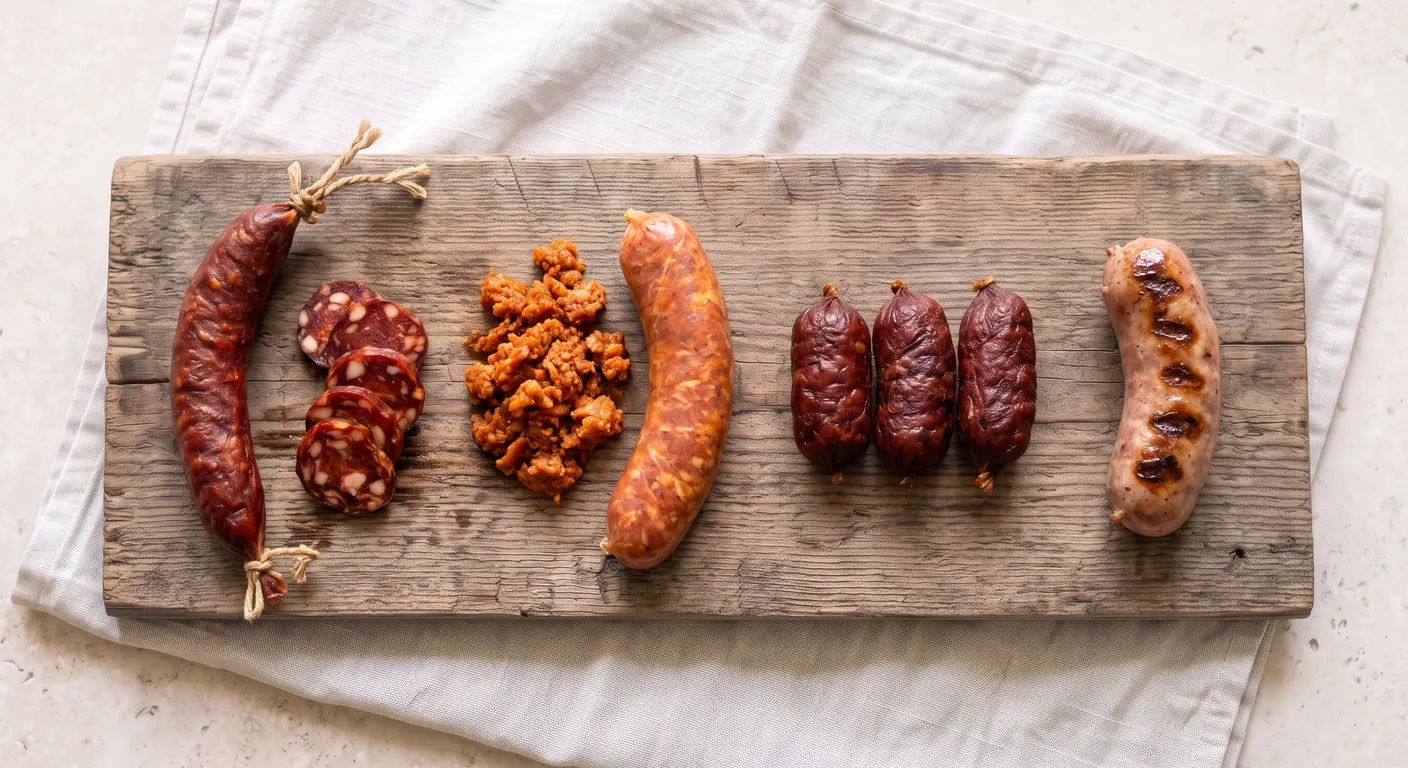 AI-generated
Picture someone in a supermarket, holding a red sausage and thinking about a cheese board. With one kind of chorizo, that is an excellent evening. With another, it is a raw pork problem.
Portuguese and Spanish settlers carried the idea around the world, and everywhere it landed, people changed what they had to. So the word stayed the same and the sausage often did not. Let's go through four versions, starting where the name comes from.
Spain: already finished when you buy it
 AI-generated
Spanish chorizo is the one for the cheese board. Makers season fatty pork, fill it into casings and hang it up to dry until it can be eaten as it is. There are hundreds of regional versions, so one with written rules makes a good example: Chorizo de Cantimpalos, from Segovia in central Spain. The EU protects its name, which means only makers from that area who follow the recipe may use it.
It is 70 to 80 percent lean pork, with 18 to 25 grams of pimentón (Spanish paprika) for every kilo of meat. Garlic is optional, up to 4 grams per kilo, and so is oregano, up to 0.2 grams. Curing takes at least 21 days for the thin strings and 40 days for the fat ones. And Spain's trade body describes the taste as pleasant and not spicy, which surprises people who assumed red means hot.
Now the smoke. Plenty of Spanish chorizo tastes smoky, and some of it does go through a smokehouse. But the Cantimpalos rules describe only drying, no smoking. At least half of its pimentón has to be Pimentón de La Vera, a paprika dried over oak or holm oak fires in Extremadura, so here the smoke arrives in the spice jar. Softer cooking chorizos exist as well, the kind that get simmered in cider for chorizo a la sidra, so even in Spain it pays to read the label.
Mexico: raw, loose and not for your cheese board
 AI-generated
Here is the raw pork problem. Chorizo mexicano starts with fresh ground pork, mixed with chillies such as ancho and guajillo, plus vinegar and spices. It looks like a sausage and behaves like mince: you squeeze it out of its casing, fry it in a pan and stir it into eggs or fold it into a taco. It has not been cured, so it has to be cooked through before anyone eats it.
Swap the two and both dishes fail. Spanish chorizo stays in stubborn little coins where you wanted a loose, saucy filling, and Mexican chorizo falls apart on the board, if it even makes it that far. Even the word changes: Mexicans say the z like an s, Spaniards like the th in thing.
Toluca, west of Mexico City, has its own version: chorizo verde, which gets its green from fresh chillies and herbs instead of dried red chillies. It is fairly young, and accounts often date it to around the 1970s.
Goa: toddy vinegar instead of wine
 AI-generated
On India's west coast the Portuguese left behind a sausage whose recipe relied on wine. Cooks in Goa replaced it with toddy vinegar, made from palm sap, and added chillies and Indian spices. In the north, a splash of feni, the local spirit, often went in too. The result is Goan chorizo, or chouris as people call it there.
The old method, as Alvarinho J. Luis describes it in the newspaper The Goan, is wonderfully unhurried. The meat was salted and pressed overnight, mixed with the marinade, stuffed into cleaned gut and dried in the sun. Then the sausages hung on a bamboo rod high in the kitchen, soaking up smoke from the firewood stove.
It goes into pulao, a spiced rice dish, or into a bread roll as choris pão. Pork itself has a darker history here: according to the book Cozinha de Goa by Fatima da Silva Gracias, it was not widely eaten in Goa in the 1700s, and under the Inquisition, the Church's court against heresy, refusing it could count as an offence. Few sausages arrive with that much baggage.
“They are spicier, with a generous use of vinegar.”
Río de la Plata: fresh, pale and straight onto the fire
 AI-generated
Río de la Plata is the wide estuary between Argentina and Uruguay, and in both countries the red disappears altogether. The chorizo of Uruguay is a fresh, coarse sausage of pork, sometimes with a little beef, seasoned with garlic, oregano, nutmeg and pepper. No curing, no vinegar, and at most a little paprika. If you buy one expecting Spain, you are in for a shock when you cut it open.
Its home is the grill. The story of the choripán, chorizo in bread, goes back to the mid-19th century, to gauchos, the cowhands of the plains, with hot embers and little in the way of plates. It later moved to the cities as street food, and today it belongs outside football grounds, preferably with chimichurri, a sharp herb sauce.
At a glance
Four chorizos on one table, to keep in your head at the meat counter.
| Spain | Mexico | Goa | Río de la Plata | |
|---|---|---|---|---|
| When you buy it | Cured, ready to eat | Raw | Dried, cooked before eating | Fresh and raw |
| Colour comes from | Pimentón | Dried chillies (green in Toluca: fresh chillies and herbs) | Chillies | Little or none: it stays pale |
| The sour or sharp note | Usually none: mild, often not hot | Vinegar and chilli | A lot of toddy vinegar, with chilli | Garlic and oregano, no vinegar |
| Smoke | Often from the paprika; some are smoked too | None | From the kitchen fire, traditionally | From the grill |
| How to use it | Sliced cold, or in the pan | Squeezed out of the casing and fried | In pulao, or fried for bread | On the grill, whole or split |
| Classic dish | Huevos rotos con chorizo | Eggs or tacos with chorizo | Choris pão | Choripán |
When you buy it
- Spain
- Cured, ready to eat
- Mexico
- Raw
- Goa
- Dried, cooked before eating
- Río de la Plata
- Fresh and raw
Colour comes from
- Spain
- Pimentón
- Mexico
- Dried chillies (green in Toluca: fresh chillies and herbs)
- Goa
- Chillies
- Río de la Plata
- Little or none: it stays pale
The sour or sharp note
- Spain
- Usually none: mild, often not hot
- Mexico
- Vinegar and chilli
- Goa
- A lot of toddy vinegar, with chilli
- Río de la Plata
- Garlic and oregano, no vinegar
Smoke
- Spain
- Often from the paprika; some are smoked too
- Mexico
- None
- Goa
- From the kitchen fire, traditionally
- Río de la Plata
- From the grill
How to use it
- Spain
- Sliced cold, or in the pan
- Mexico
- Squeezed out of the casing and fried
- Goa
- In pulao, or fried for bread
- Río de la Plata
- On the grill, whole or split
Classic dish
- Spain
- Huevos rotos con chorizo
- Mexico
- Eggs or tacos with chorizo
- Goa
- Choris pão
- Río de la Plata
- Choripán
The cousins
The family keeps going. Portugal's chouriço is smoked and has wine in the mix, Brazil turned the Portuguese pork sausage linguiça into a barbecue staple, and Chile grills its fresh longaniza for its own version of the choripán. They all answer the same question differently: what do you do with pork, salt and whatever grows nearby?
Still curious?
Can you eat chorizo raw?
Cured Spanish chorizo, yes: it is ready to eat. Mexican and River Plate chorizo, no: they are raw meat and must be cooked through. If the pack says cook before eating, believe it.
What is the difference between Spanish and Mexican chorizo?
Spanish chorizo is cured and seasoned with pimentón, so you can slice it cold. Mexican chorizo is fresh, seasoned with chillies and vinegar, and fried loose in a pan.
Is chorizo always hot?
No. Spain makes both sweet and hot versions, and the rules for Chorizo de Cantimpalos describe a taste that is not spicy. The River Plate version is usually not hot either. Goan and many Mexican chorizos have more heat.
Can I use Spanish chorizo in a Mexican recipe?
It will taste good but behave differently. It keeps its shape instead of breaking into a loose filling, and it lacks the vinegar and chilli.
Sources
- Chorizo de Cantimpalos, PGI specification, Spanish Ministry of Agriculture, 2023
- Foods and Wines from Spain (ICEX), Chorizo de Cantimpalos PGI
- Pimentón de la Vera, PDO specification
- The Takeout, Mexican vs. Spanish chorizo, 2 January 2025
- Tasting Table, the differences between Spanish and Mexican chorizo
- Mexico News Daily, the chorizo of Mexico state
- Rick Bayless, green chile chorizo tacos
- Alvarinho J. Luis, Flavourful heritage of Goan chouris, The Goan, 21 September 2025
- Diario UNO, La historia del choripán, 21 April 2019