Chicago Hot Dog
Chicago Red Hot
Chicago, USA
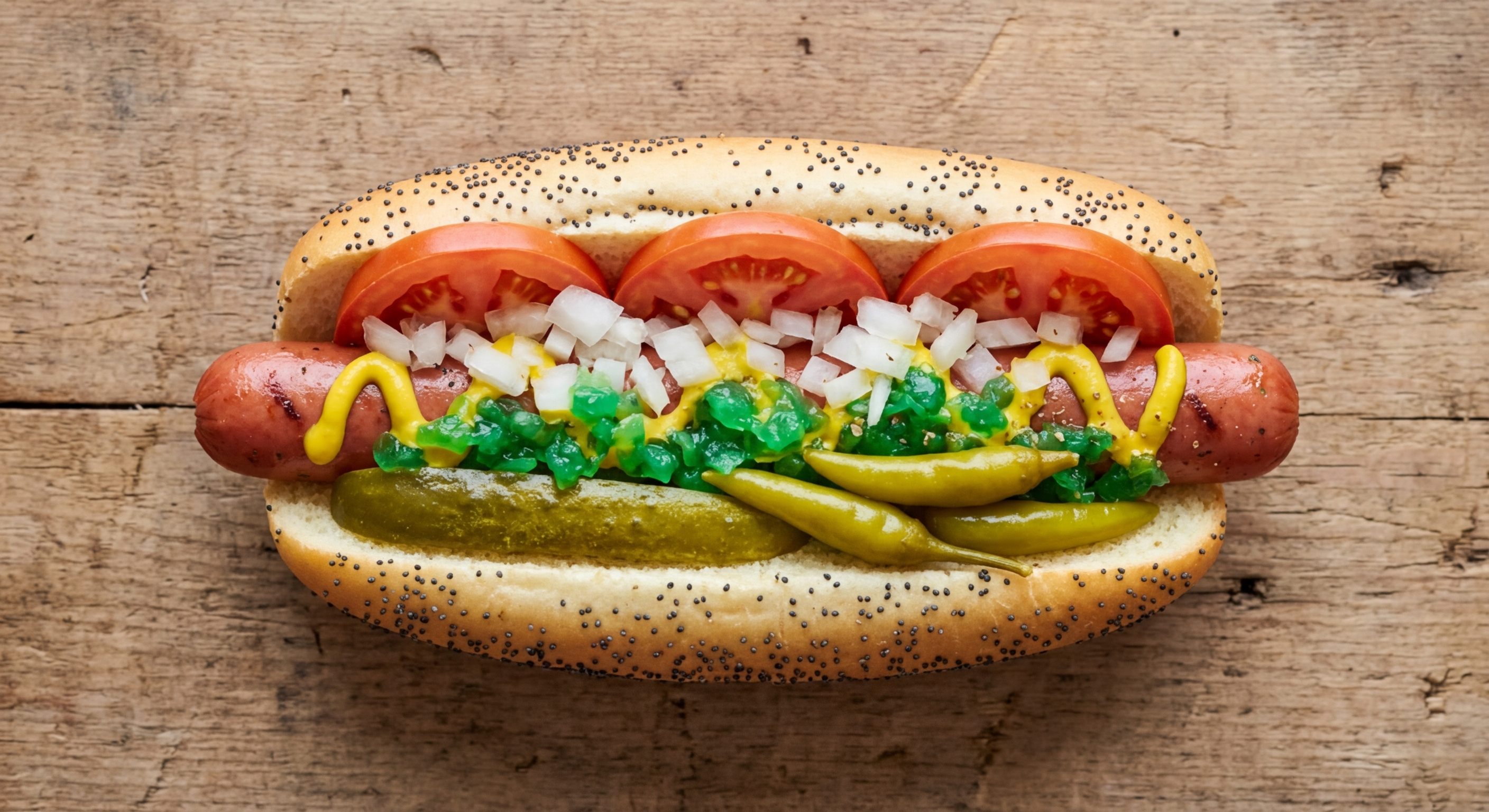
The Chicago hot dog is an all-beef frankfurter in a steamed poppy seed bun, topped with seven specific ingredients in a fixed order: yellow mustard, neon green sweet relish, chopped white onion, tomato slices or wedges, a dill pickle spear, sport peppers, and a shake of celery salt. Chicagoans call this being dragged through the garden. Ketchup is not part of the build. This is not a preference or a guideline: it is a cultural rule enforced with the seriousness of a civic ordinance. The sausage itself is a natural-casing all-beef frankfurter, cooked by steaming or simmering, never grilled in the traditional preparation. The snap of the casing when you bite through it, followed by the hot, seasoned beef inside, is the textural baseline everything else is built on.
History
The Chicago hot dog's origins run through two distinct moments in the city's history. The first is the 1893 World's Columbian Exposition, held on the South Side along the lakefront. Vienna Beef was founded that year by Emil Reichel and Samuel Ladany, two immigrants from Austria-Hungary who brought their all-beef frankfurter recipe to the fair's midway and sold it to millions of visitors. The all-beef formulation was partly practical (it satisfied both kosher and halal dietary requirements) and partly a selling point at a time when sausage fraud, adulteration with offal and filler, was common enough to be a public concern. The second formative moment came during the Great Depression of the 1930s. Hot dog stands multiplied across the city because a nickel could buy a frankfurter with enough vegetables piled on top to constitute a meal. Greek and Jewish immigrant vendors on the Maxwell Street market and along the city's transit corridors built the topping formula that became the standard: mustard, relish, onion, and peppers, with tomato and pickle added as the Depression-era abundance of cheap produce became available. By the time the economy recovered, the seven-topping build was fixed. The no-ketchup rule is harder to date precisely, but it represents the flip side of the same logic: ketchup adds sweetness and masks the flavours of the toppings, and stands that built their reputation on the full seven-ingredient experience rejected it. The rule hardened into culture over decades, enforced not by law but by the disapproval of every counter worker in the city. Vienna Beef has supplied Chicago's hot dog stands for over a century and remains the canonical supplier. Their natural-casing frankfurter, called the 5:1 (five sausages per pound), is the reference format for what a Chicago dog is supposed to contain.
Ingredients
Preparation
The frankfurter goes into simmering water or a steamer for 5 to 7 minutes. The casing should stay intact: a hard boil splits it and loses the snap. The bun is steamed separately for 30 to 45 seconds, enough to warm and slightly soften it without making it wet. Assembly follows a fixed sequence. Mustard goes on one side of the dog, relish on the other. Chopped onion scatters across both. The tomato wedges get tucked into one side of the bun between the bread and the sausage, not on top. The pickle spear goes into the opposite side. Sport peppers lay across the top of the sausage, and celery salt finishes last with a light shake across the whole construction. The order matters for two reasons: structural (the tomato and pickle hold the dog in place) and flavour (the celery salt on top seasons the toppings it lands on). A char dog variant exists, where the frankfurter is split down the middle and laid cut-side down on a flat griddle until the surface chars. The char dog has a different flavour profile, smokier and with more Maillard browning, and a different texture from the steamed version.
Taste
The first bite hits five flavours at once. The beef is savory and slightly garlicky with the clean richness of natural casing and rendered fat. The mustard is sharp and tangy. The neon relish is sweet, brighter and more insistent than European pickle relishes. The sport peppers carry a moderate heat that builds over the course of eating. Celery salt threads through the whole thing, tying the vegetables and the casing together in a way that is hard to identify until it is absent.
Texture
The casing snaps when you bite through it: this is non-negotiable in the Chicago tradition, and why skinless all-beef frankfurters do not qualify as Chicago dogs. The beef inside is dense, finely ground, and hot. The poppy seed bun is soft and slightly compressible, with a thin crumb that yields to the dog without fighting it. The pickle spear contributes crunch; the tomato wedges add a brief acidic burst of juice. The sport peppers have a thin skin and a tender bite.
Rituals & Traditions
No ketchup. Not on the dog.
Ketchup on a Chicago hot dog is the fastest way to identify yourself as someone who has not thought about what they are ordering. It is not a personal preference that other people tolerate: it is a structural replacement that masks the relish, overwhelms the mustard, and defeats the celery salt. Chicago hot dog stand workers have been known to refuse the request, redirect the customer to a bottle of ketchup placed pointedly near the fries, or simply stare until the customer reconsiders. The rule exists because the seven toppings already contain all the sweetness the build needs. The neon relish is very sweet. Ketchup is redundant and then some.
The order of toppings is not decorative
Every Vienna Beef certified stand follows the same assembly sequence, and there is logic behind it. Mustard and relish go on the dog first because they are sauces and need contact with the meat to warm slightly and integrate. Onion goes across both. Tomato and pickle go into the sides of the bun because they are structural: they keep the dog from rolling out when you pick it up. Sport peppers go on top last before the celery salt because they are garnish-weight: heavy enough to stay put, light enough not to compress the bun. Celery salt at the very end means it seasons what it falls on, not just the dog.
Vienna Beef or nothing
Vienna Beef is not just a brand preference among Chicago hot dog stands: it is the category definition. Founded in 1893 by Emil Reichel and Samuel Ladany at the World's Columbian Exposition, Vienna Beef has supplied Chicago's stand culture for over a century. Their 5:1 natural-casing all-beef frankfurter is the ingredient the seven-topping formula was built around. Other all-beef natural-casing frankfurters exist, and some are excellent, but a Chicago hot dog made with Vienna Beef has a specific diameter, fat content, and garlic note that the format assumes. Stands that deviate from Vienna Beef are not considered authentic by most Chicago eaters, though the argument about whether this amounts to brand loyalty or genuine flavour difference runs on indefinitely.
Eat it wrapped, standing up
A Chicago hot dog comes wrapped in wax paper or in a paper sleeve. This is not packaging to remove before eating: you peel it back as you eat, using the paper as a grip and a drip catcher. The toppings will migrate. The tomato will release juice. The relish will smear on your hand. This is eating in the correct format. At a drive-in like Superdawg, you eat in the car with the same approach: the paper stays on, and you eat from one end to the other.
Recipes
Authentic Chicago Dog at Home
Chicago Hot Dog
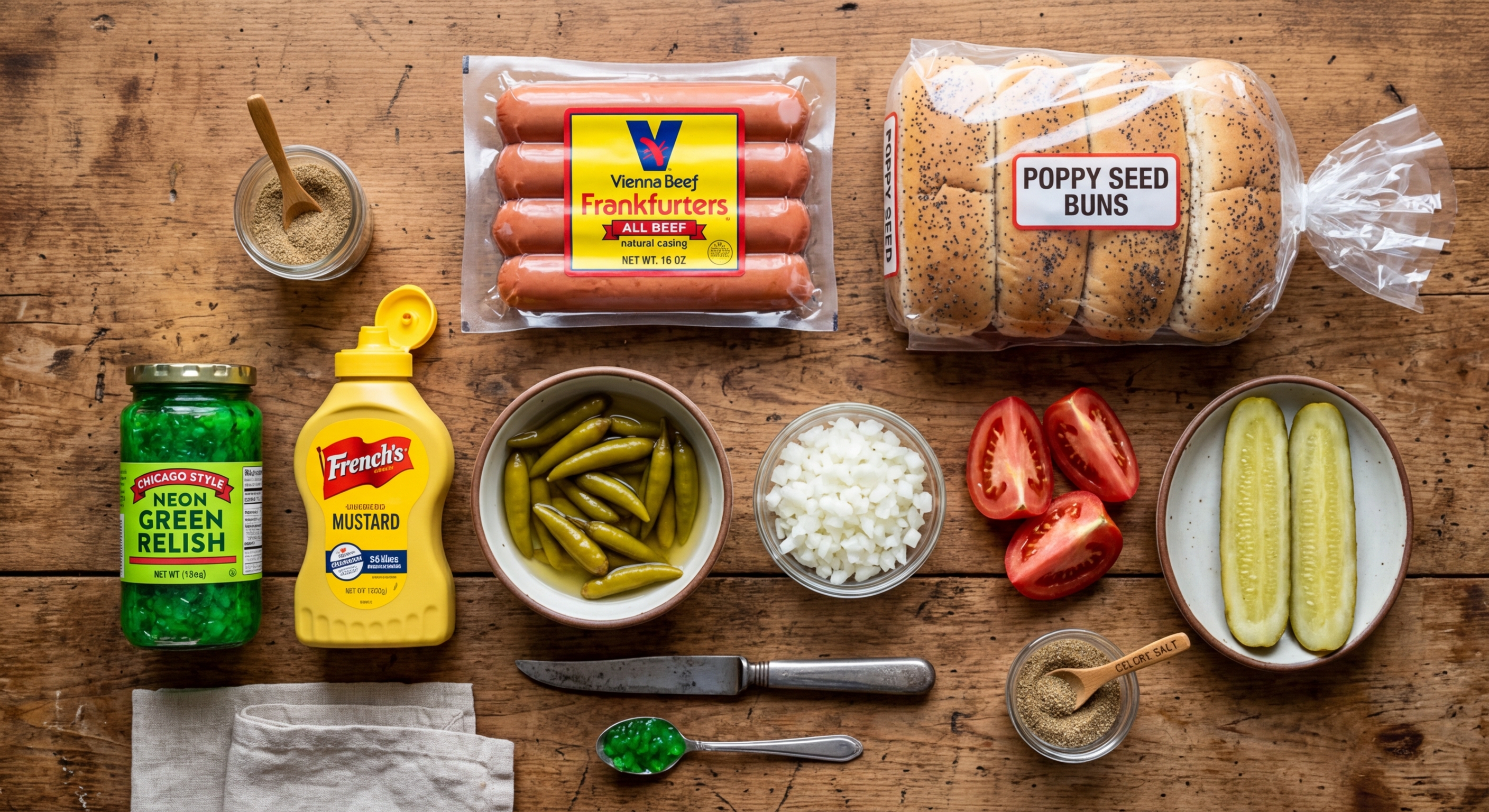
Building a Chicago dog outside Chicago depends on sourcing the right components. Vienna Beef ships nationally. Neon green relish is the hardest ingredient to find locally: it gets its colour from food dye, not from the cucumbers themselves, and a grocery store sweet relish will not do. Sport peppers are similarly specific. This recipe covers where to find everything and how to assemble it.
Chicago Char Dog
Chicago Hot Dog
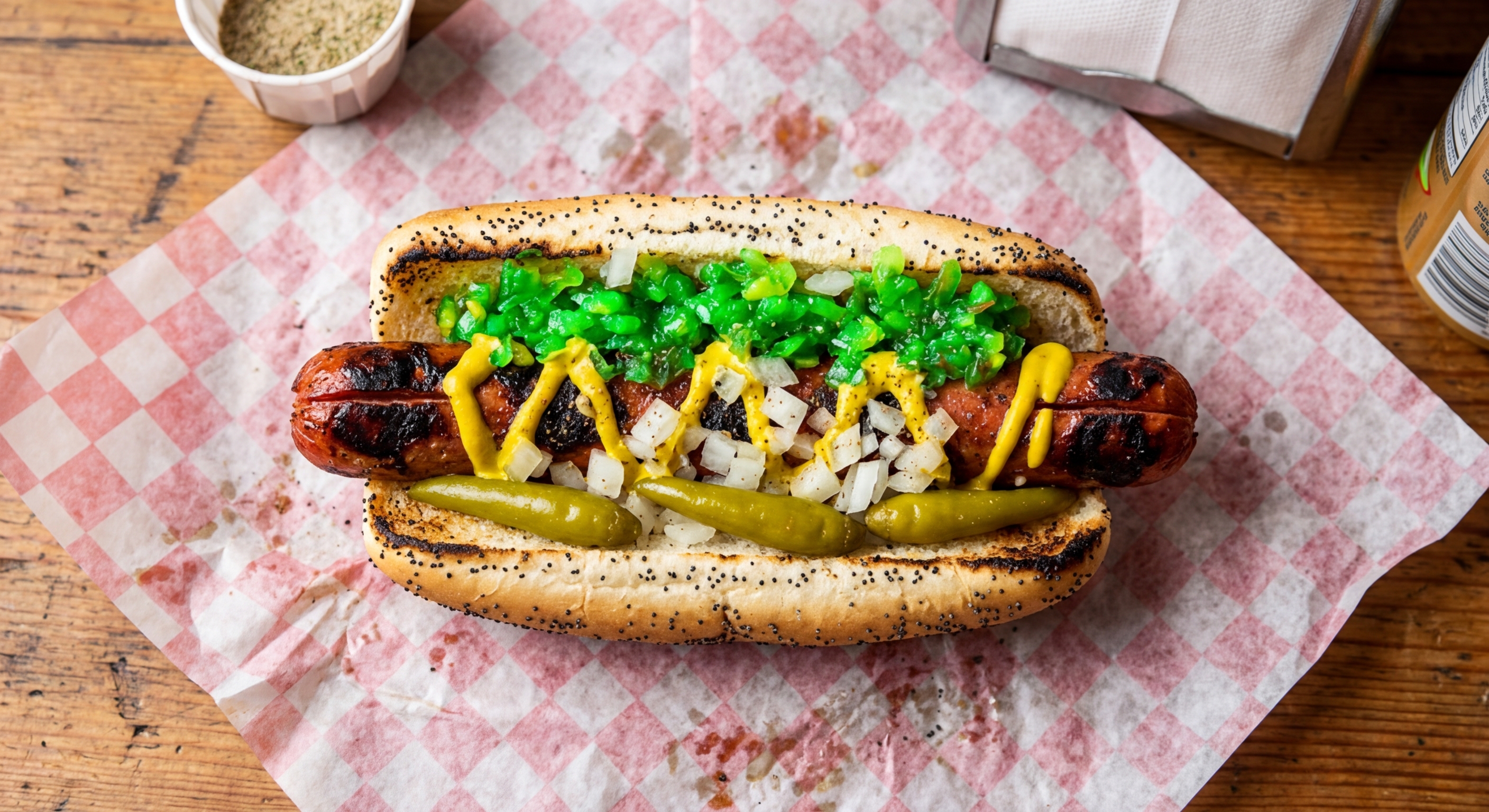
The char dog is the grilled variant of the Chicago hot dog: the frankfurter is split lengthwise and laid cut-side down on a flat-top griddle or charcoal grill until it chars and curls at the edges. The split surface browns and crisps while the inside stays juicy. Toppings follow the same Chicago rules, but the sausage has smoke and char instead of the clean snap of a steamed dog.
Chicago Dog: Dragged Through the Garden
Chicago Hot Dog
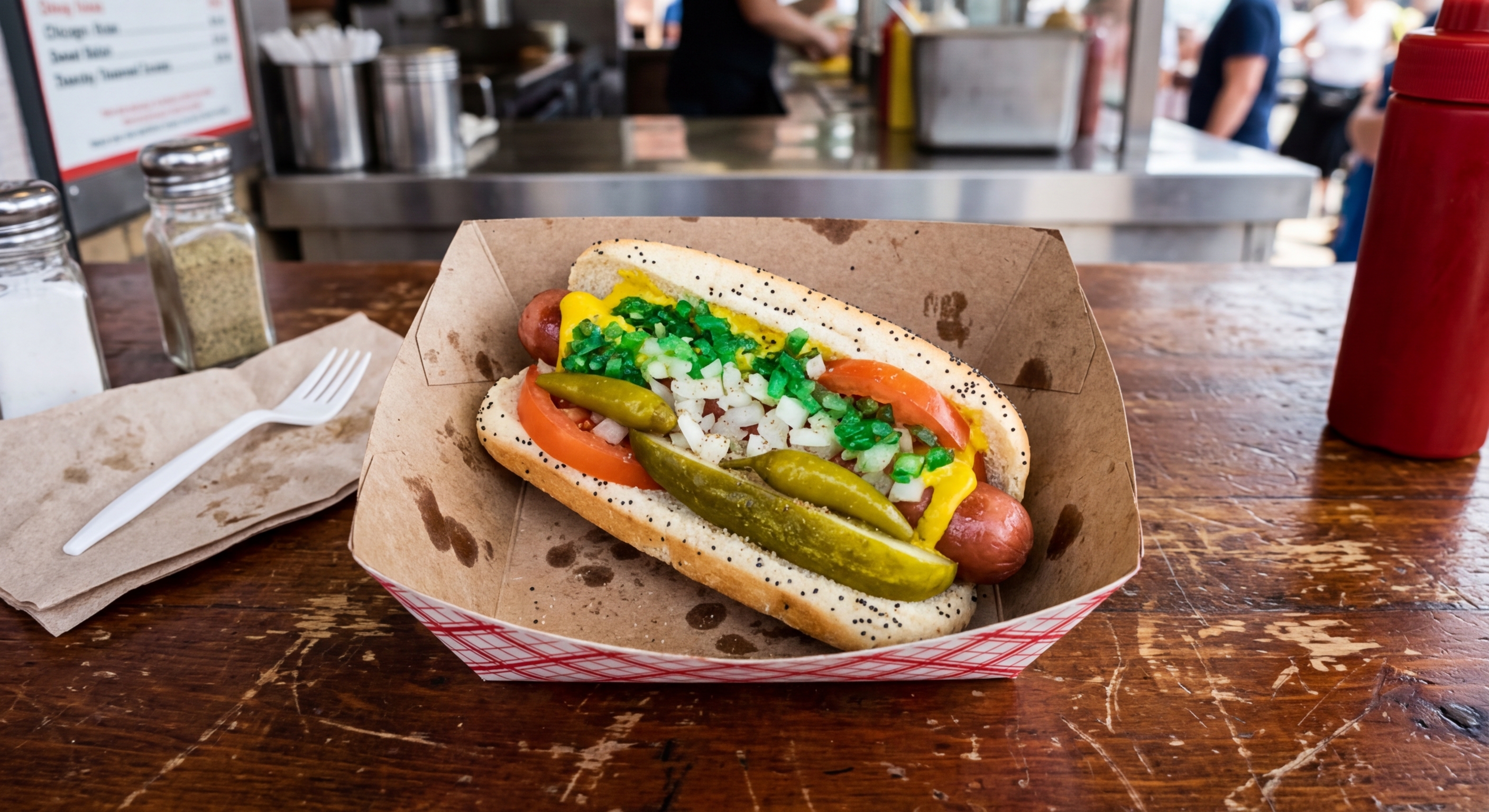
The canonical Chicago-style hot dog: an all-beef frankfurter in a steamed poppy seed bun with all seven toppings in the correct order. Yellow mustard first, then neon green relish, white onion, tomato, dill pickle spear, sport peppers, and a shake of celery salt on top. No ketchup. Not ever.
Depression Dog
Chicago Hot Dog
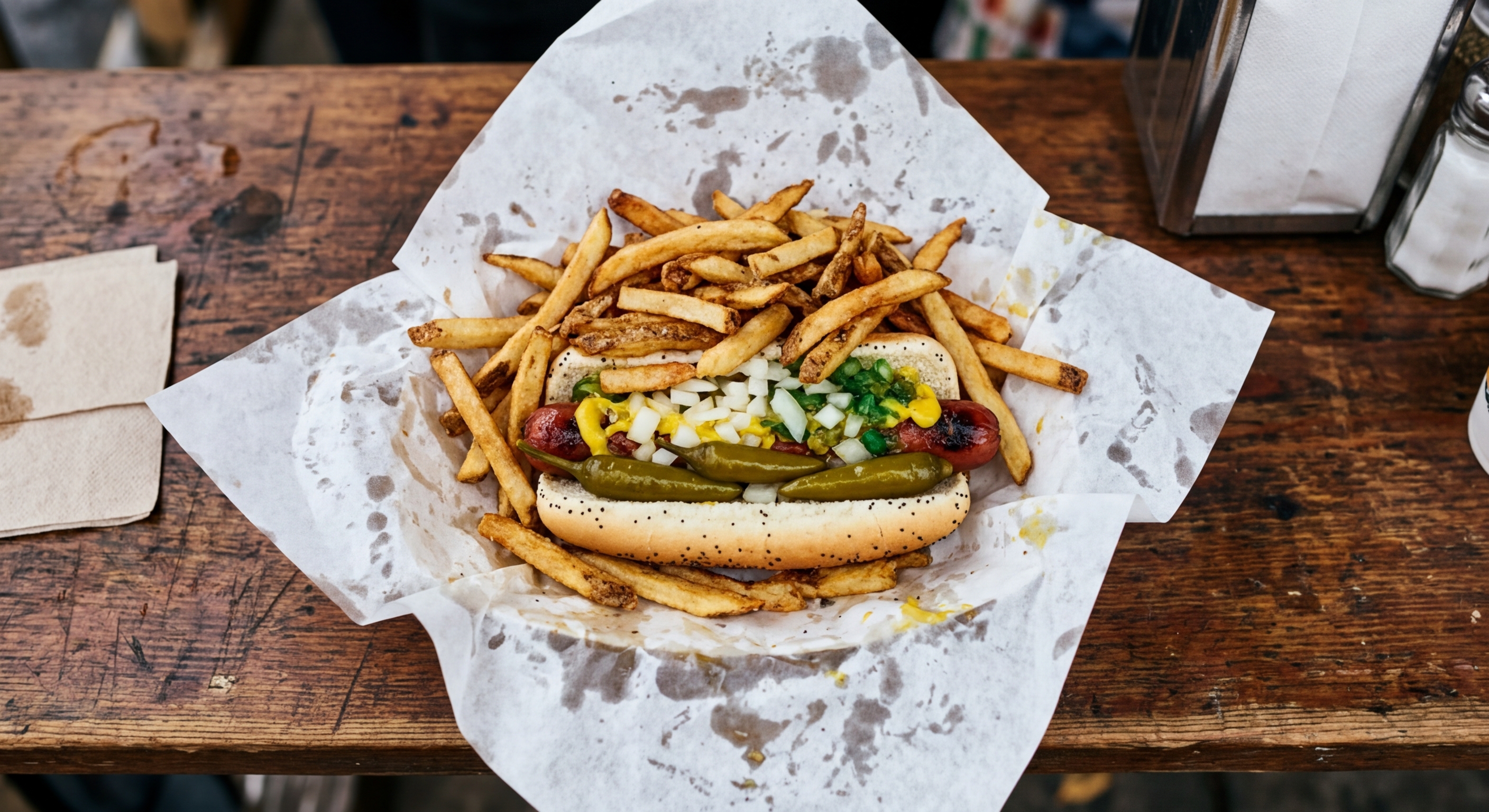
The Depression Dog predates the full seven-topping version. In the 1930s, Chicago hot dog stands sold a stripped-down build: mustard, onion, relish, and sport peppers, with fries piled on top or tucked alongside in the wrapper. Gene & Jude's in River Grove still serves it this way. No tomato, no pickle spear, no celery salt. The fries are part of the dish, not a side.
The Combo: Italian Beef and Chicago Dog
Chicago Hot Dog
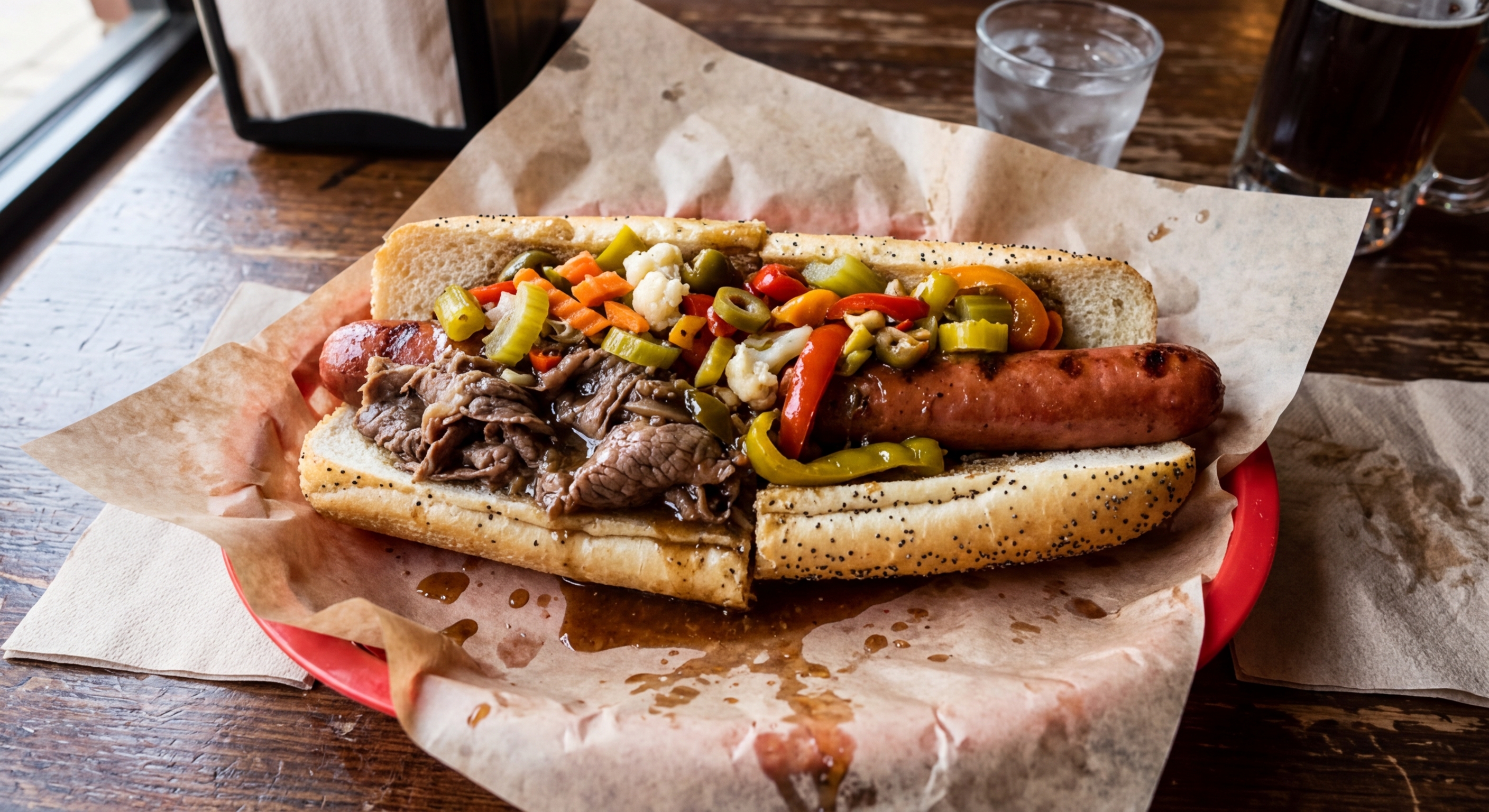
The Combo is a Chicago invention that requires a moment of explanation: it is an Italian beef sandwich with a Chicago-style hot dog tucked inside it, sharing the same roll, dipped in the beef jus together. The hot dog contributes snap and garlic; the beef brings thin-sliced seasoned roast with giardiniera. One sandwich, two proteins, zero redundancy. Portillo's serves it. So does Al's Beef.
Maxwell Street Polish
Chicago Hot Dog
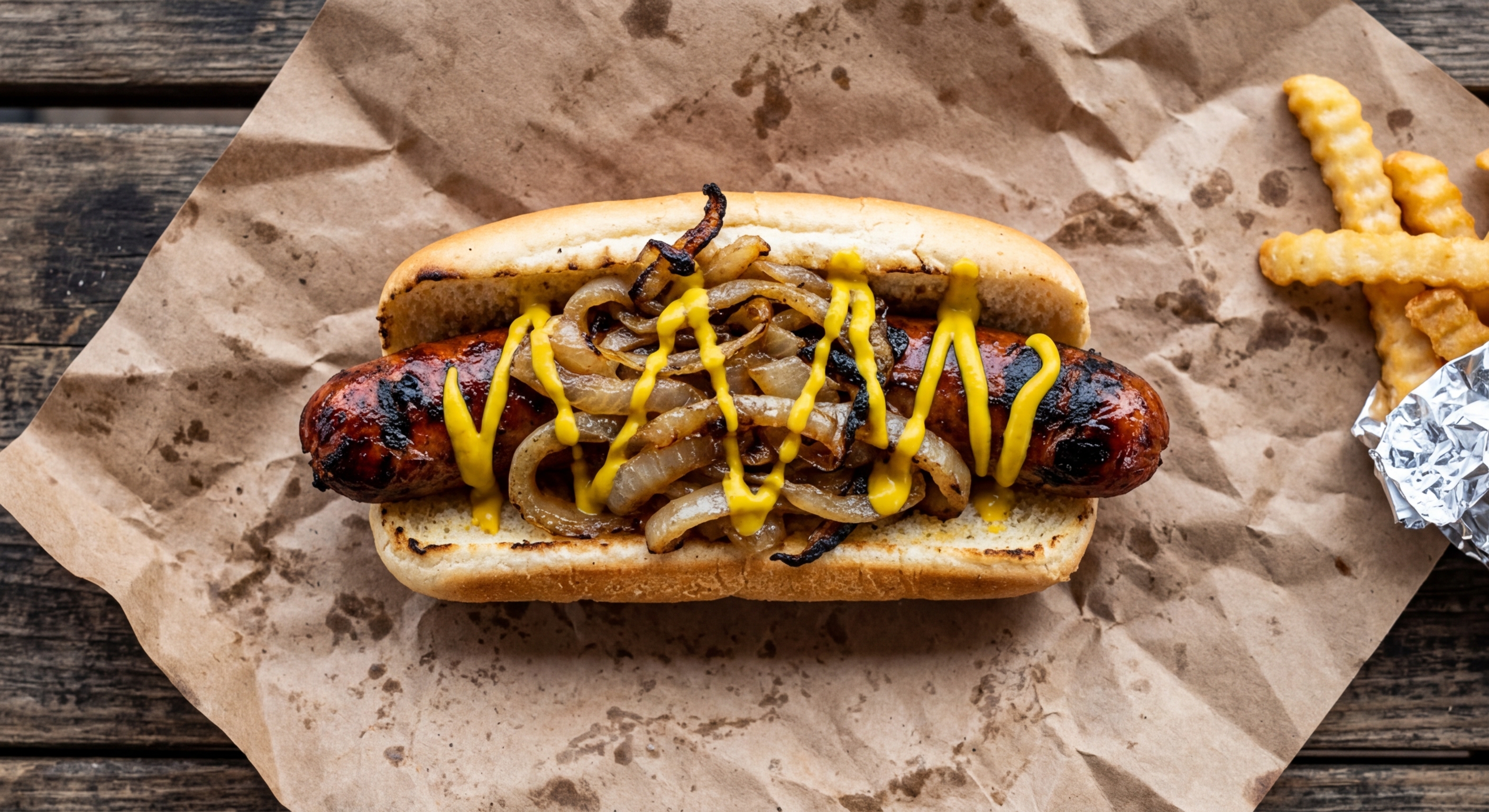
The Maxwell Street Polish is Chicago's other great sausage sandwich and the close cousin of the hot dog. A grilled or charred Polish sausage goes into a bun with yellow mustard and a heap of grilled onions, sometimes with sport peppers or piccalilli relish alongside. It traces back to the Maxwell Street open-air market, where Eastern European Jewish vendors sold food from pushcarts from the 1880s until the market's demolition in the 1990s. Jim's Original, which has operated near the old Maxwell Street site since 1939, remains the reference point.
On the Map
Where to Eat
Byron's Hot Dogs
Chicago, United States
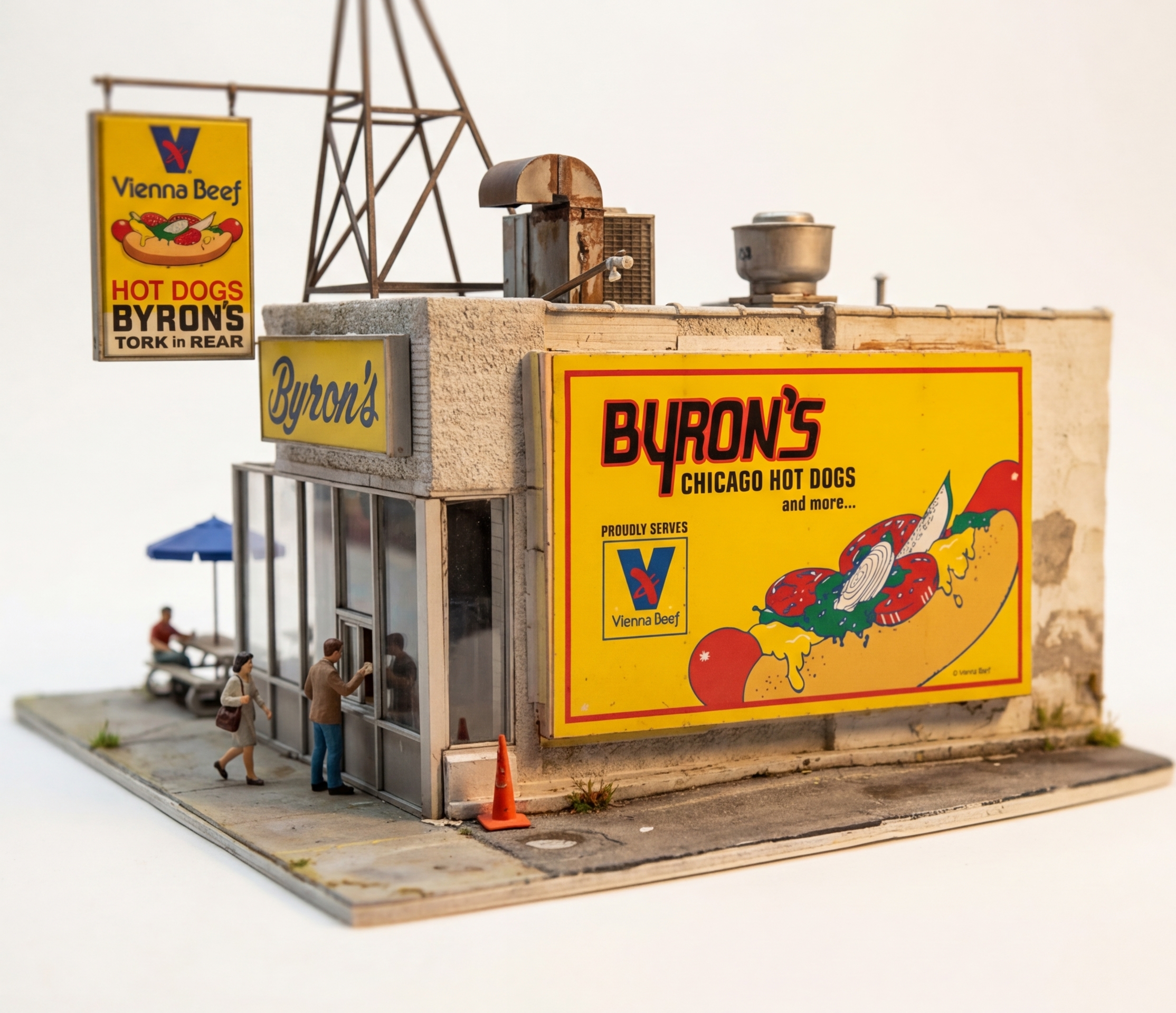
Byron's has operated on Irving Park Road in Lakeview since the 1960s, a neighbourhood stand that has outlasted dozens of competing concepts on the same stretch. The sign says 'Through the Garden' and the staff mean it: every Chicago dog here gets all seven toppings in the canonical order, served on a steamed poppy seed bun. The stand is a Vienna Beef certified location and one of the reference points locals use when explaining what the style is supposed to taste like. Cash only, counter service, a small number of stools inside.
Gene & Jude's
River Grove, United States
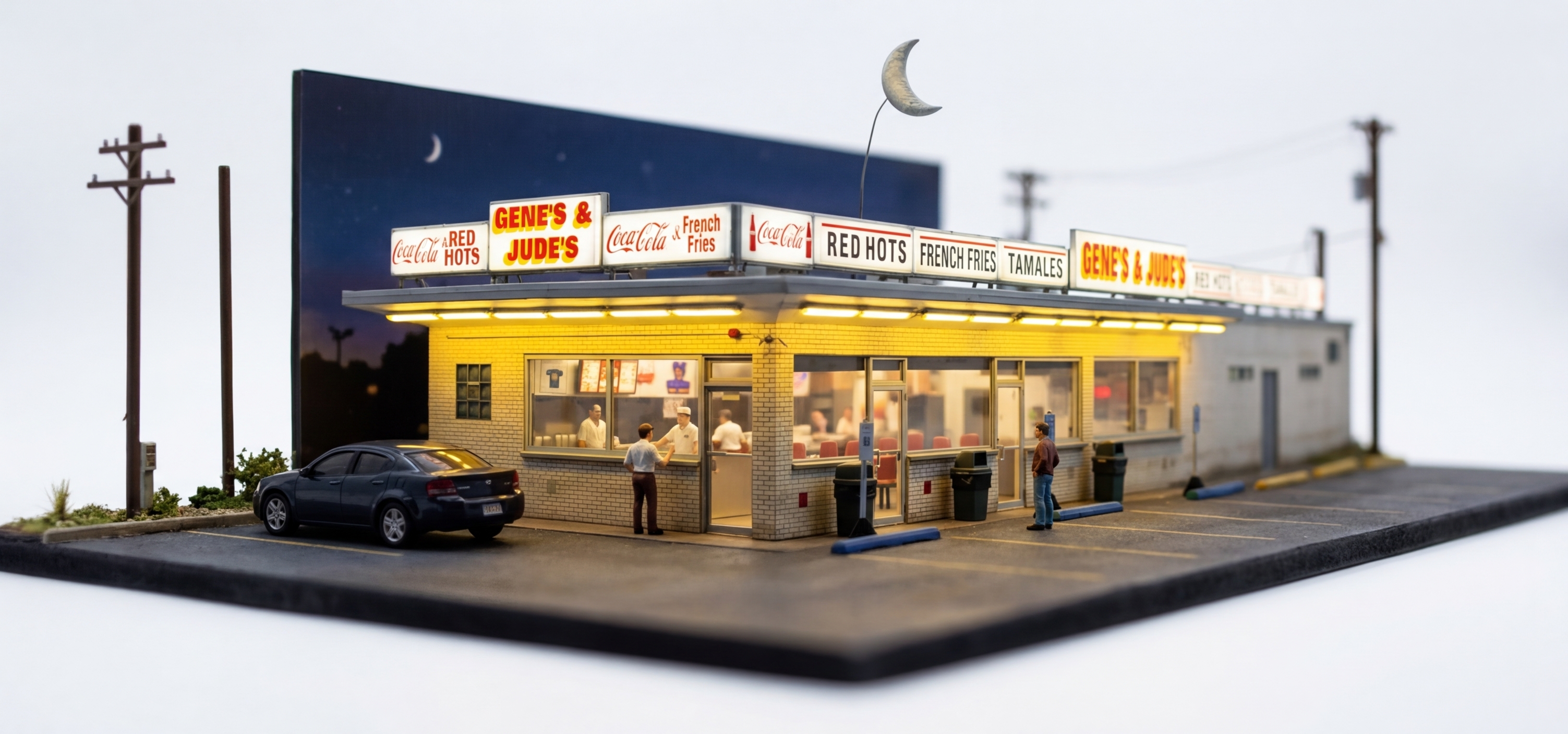
Gene & Jude's has been selling hot dogs at 2720 N. River Road in River Grove since 1946, and the menu has barely changed. You get a hot dog. You get fries, piled directly on top of the dog in the wrapper. There are no tomatoes, no pickle spear on this particular dog: Gene & Jude's serves a Depression-style Chicago dog, stripped to mustard, onion, relish, and sport peppers, with the fries buried underneath. No seats. No ketchup. No substitutions. The line moves fast and the staff have been doing this long enough that they do not need to ask twice. Food Network, countless travel guides, and three generations of Chicago eaters have called it the best hot dog in America.
Portillo's Chicago (River North)
Chicago, United States
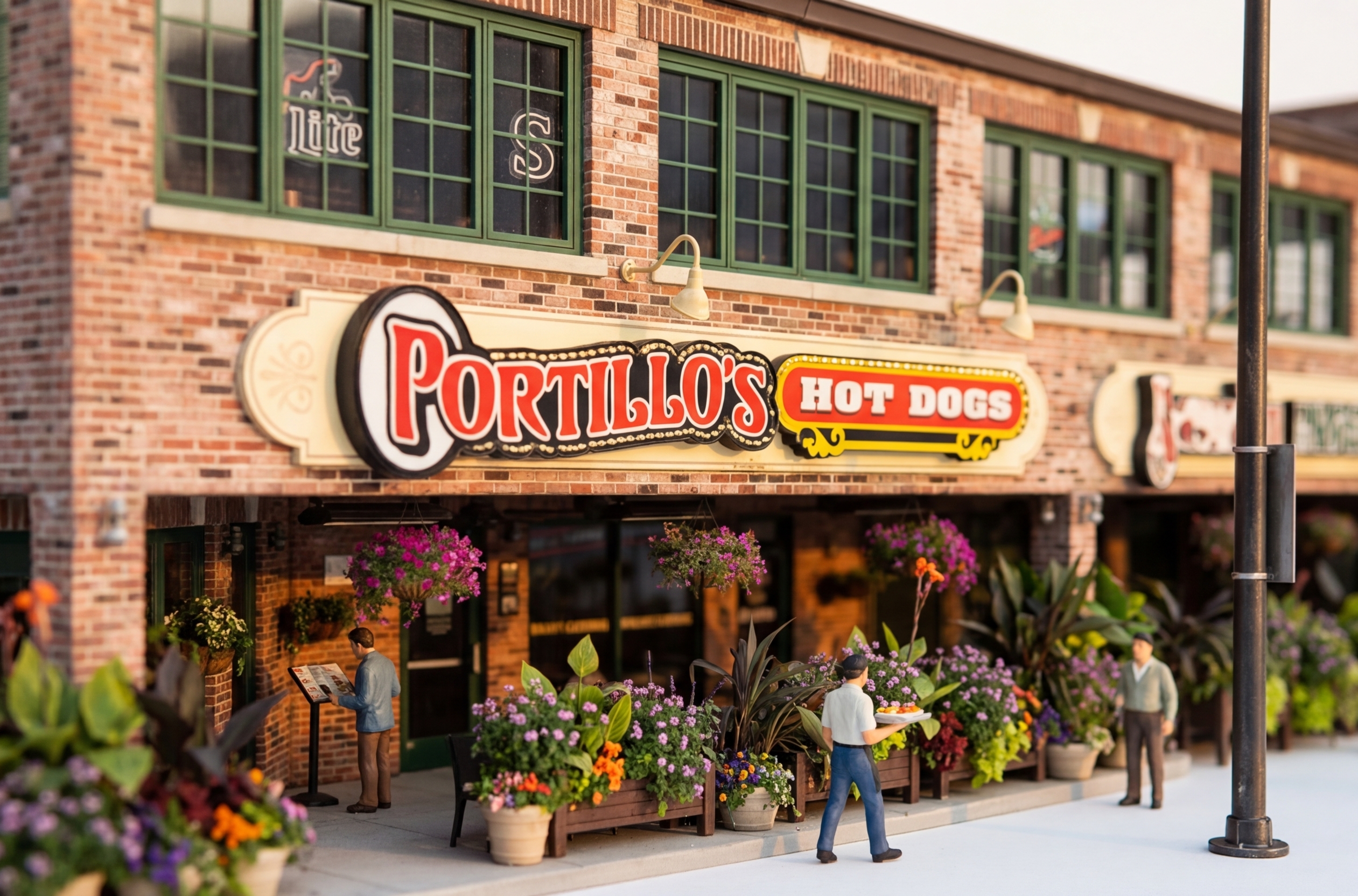
Dick Portillo opened the original location in Villa Park in 1963 under the name The Dog House, a trailer with no running water. The chain grew from that into dozens of locations, but the River North restaurant at 100 W. Ontario Street, opened in 1994, remains the flagship Chicago city location. The two-storey building is themed to the 1930s Prohibition era, with vintage photographs and artifacts covering the walls. Portillo's serves the full Chicago dog alongside Italian beef sandwiches and Chicago-style polish sausage. The volume is high and the line can stretch out the door at lunch, which the staff handle with the efficiency of a well-run assembly line.
Superdawg Drive-In
Chicago, United States
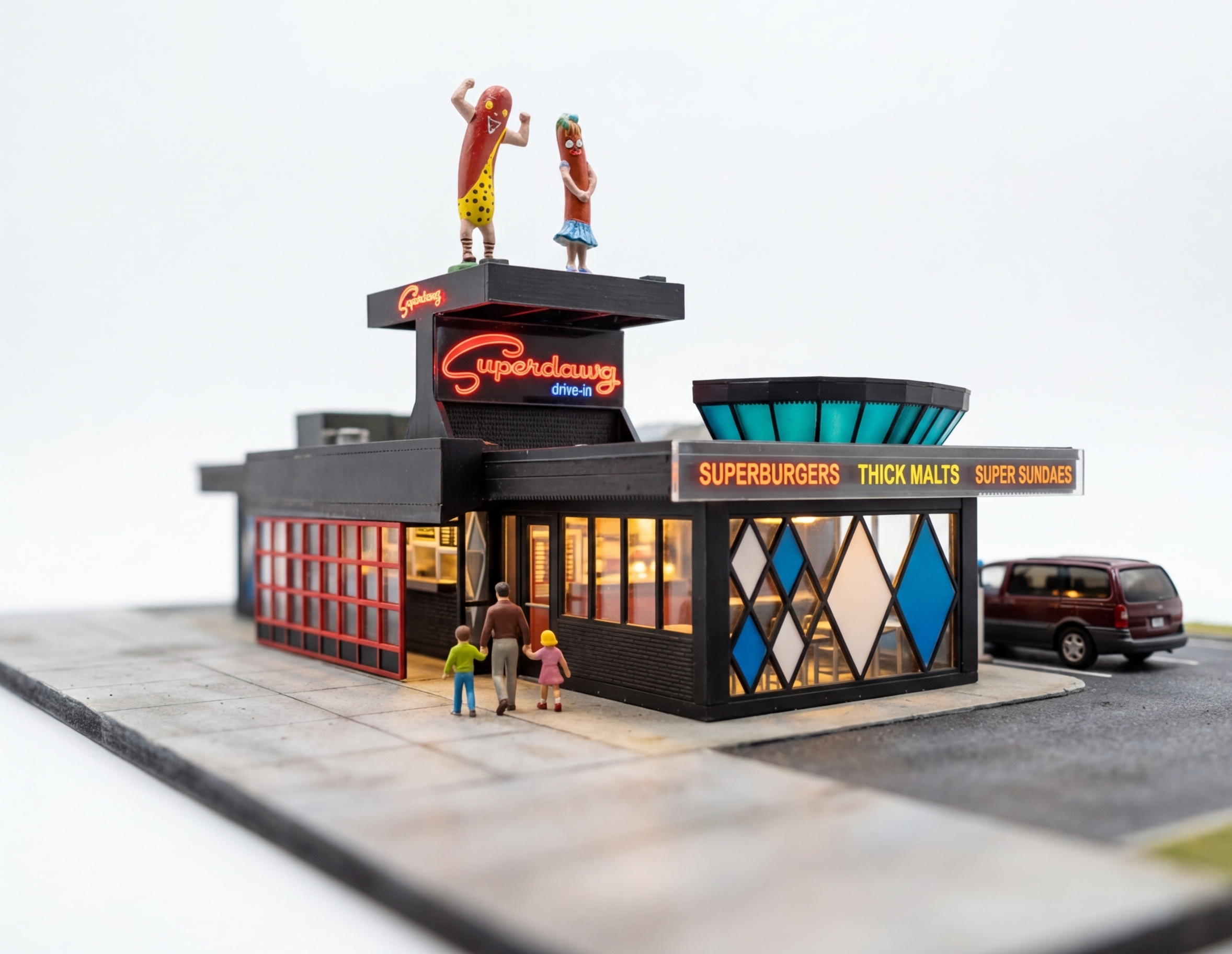
Superdawg opened in 1948 when Maurie and Flaurie Berman set up a car-hop drive-in on the corner of Milwaukee, Devon, and Nagle in the Norwood Park neighborhood. Two giant hot dog statues, Maurie and Flaurie, stand on the roof and have been the landmark ever since. You pull in, order on a speaker, and a carhop brings the food to your window on a tray. The Superdawg itself is an all-beef frankfurter in a mustard-yellow box nestled in crinkle-cut fries, dressed with the Chicago toppings. The place is still family-owned and operates exactly as it did in 1948.