Guides Bratwurst, compared
Three bratwursts, three rulebooks and one boxing match
"Bratwurst" sounds like one sausage. Ask in Nuremberg, Thuringia or the Swiss city of St. Gallen and you get three different answers. The argument over who came first even ended up in a ring, with gloves.
 AI-generated
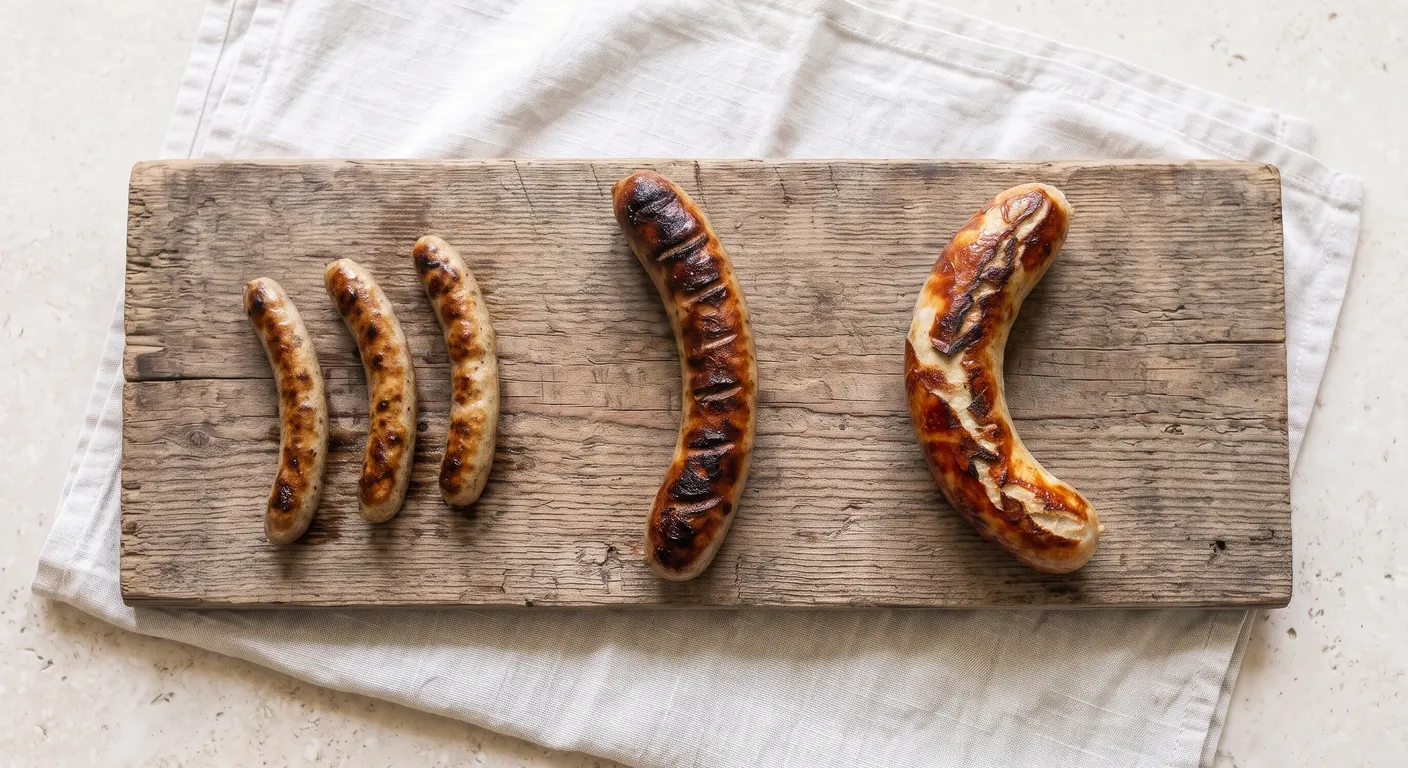
Order a bratwurst in Nuremberg and you may wonder where the rest of it went. Order one in Thuringia and it sticks out of the bread roll on both sides. Order one in St. Gallen and it arrives plump and golden, with white filling showing through the split skin.
All three call themselves bratwurst, and all three have a protected name: only sausages made in the right place, by written rules, may carry it. Beyond that, they agree on very little. So let's line them up, smallest first.
Nürnberger: small, and not sorry about it
 AI-generated
The Nürnberger Rostbratwurst is 7 to 9 centimetres long and weighs 20 to 25 grams. That is why nobody orders just one. The local unit is Drei im Weggla, Franconian dialect for three in a roll, with mustard.
The rules are about as tight as its skin, which is sheep casing. Grinding, mixing and filling must all happen inside the city of Nuremberg, not merely somewhere nearby. The EU rules allow up to 35 percent fat and leave the spice mix to each butcher's recipe, but say that marjoram above all is typical.
The best story about its size says butchers passed the sausages through keyholes after closing time. The city's own website says this cannot be confirmed, which is a shame. It does confirm the appetite: the football club 1. FC Nürnberg reportedly sells about 350,000 of them per season. One place to buy them is the butcher Metzgerei Pfettner, in the north of the city since 1927.
Thüringer: long, coarse and looking for a fire
 AI-generated
Now the Thüringer Rostbratwurst. It is 15 to 20 centimetres long and weighs 100 to 150 grams, so one of them outweighs four to seven Nürnberger. The whole production has to happen in the state of Thuringia, which gives its makers more room than Nuremberg's city limits.
It is also the leaner of the two Germans, at about 20 percent fat according to the German consumer testers at Stiftung Warentest: coarsely defatted pork, pork cheeks and sometimes beef. Caraway, marjoram and garlic do the talking. You can buy it raw or scalded (already pre-cooked), which is worth a glance at the pack, and it usually ends up in a bread roll with mustard.
Its proudest historical document is wonderfully unglamorous. In a monastery's accounts in the Thuringian town of Arnstadt, in 1404, someone wrote down "1 Groschen für Bratwurstdärme": one groschen for bratwurst casings. No poem, no feast, just an invoice. Thuringia has built a museum around it. In Erfurt, Thuringia's capital, the grill restaurant Faustfood cooks them over charcoal indoors, which helps in February.
St. Galler: white, mild and veal-heavy
 AI-generated
Cross into Switzerland and the sausage changes colour. A St. Galler Bratwurst is white, because it contains veal and milk and goes through hot water or steam before it ever sees a grill. It is heated to 68 °C, chilled in ice water and sold like that, so at home you only have to give it a browned skin.
The Swiss rulebook is the most exact of the three. The standard mix is about 28 percent back fat, 24 percent veal, 21 percent pork and 27 percent liquid, and at least a quarter of that liquid has to be milk or the same amount as milk powder. With more than half veal in the meat, it may call itself a Kalbsbratwurst. Mace (the lacy outer layer of nutmeg) and pepper are compulsory, and the result tastes mild rather than loud. The size range is generous, from 100 to 300 grams, and the Olma version, named after St. Gallen's autumn fair, is a little larger and heavier than the standard one.
It also has the oldest paper trail of the recipe. The statutes of the St. Gallen butchers' guild mentioned veal, bacon, spices and fresh milk back in 1438, and the producers say little has changed since.
Tradition-minded locals eat it with a St. Galler Bürli, a dark-crusted roll, or a piece of bread, and leave the mustard alone. Try it at the Gemperli sausage stand in St. Gallen's old town, or at the Milchhüsli by the Drei Weieren ponds above the city.
“Mustard with the sausage? Never! A St. Galler doesn't do that.”
At a glance
The three side by side, for the next time somebody at the barbecue says "a bratwurst is a bratwurst".
| Nürnberger | Thüringer | St. Galler | |
|---|---|---|---|
| Size | 7-9 cm, 20-25 g | 15-20 cm, 100-150 g | 100-300 g; the Olma version is larger and heavier than the standard one |
| Where it must be made | Inside the city of Nuremberg | In the state of Thuringia | In the cantons of St. Gallen, Appenzell (both) and Thurgau |
| Meat | Pork, with fatty cuts such as belly and jowl | Coarsely defatted pork and pork cheeks, sometimes beef | Veal, pork and back fat |
| Fat | Up to 35 % | About 20 % | Up to 26 % |
| Seasoning | Marjoram above all | Caraway, marjoram, garlic | Mild: mace and pepper, milk in the mix |
| When you buy it | In a thin sheep casing, for the grill | Raw or scalded | White and already heated through; you grill or fry it |
| How it is eaten | Three in a roll with mustard (Drei im Weggla) | In a roll with mustard | With a Bürli or bread, without mustard |
| Protected name | EU PGI since 2003 | EU PGI since 2003 | Swiss IGP (federal decision of 2007) |
Size
- Nürnberger
- 7-9 cm, 20-25 g
- Thüringer
- 15-20 cm, 100-150 g
- St. Galler
- 100-300 g; the Olma version is larger and heavier than the standard one
Where it must be made
- Nürnberger
- Inside the city of Nuremberg
- Thüringer
- In the state of Thuringia
- St. Galler
- In the cantons of St. Gallen, Appenzell (both) and Thurgau
Meat
- Nürnberger
- Pork, with fatty cuts such as belly and jowl
- Thüringer
- Coarsely defatted pork and pork cheeks, sometimes beef
- St. Galler
- Veal, pork and back fat
Fat
- Nürnberger
- Up to 35 %
- Thüringer
- About 20 %
- St. Galler
- Up to 26 %
Seasoning
- Nürnberger
- Marjoram above all
- Thüringer
- Caraway, marjoram, garlic
- St. Galler
- Mild: mace and pepper, milk in the mix
When you buy it
- Nürnberger
- In a thin sheep casing, for the grill
- Thüringer
- Raw or scalded
- St. Galler
- White and already heated through; you grill or fry it
How it is eaten
- Nürnberger
- Three in a roll with mustard (Drei im Weggla)
- Thüringer
- In a roll with mustard
- St. Galler
- With a Bürli or bread, without mustard
Protected name
- Nürnberger
- EU PGI since 2003
- Thüringer
- EU PGI since 2003
- St. Galler
- Swiss IGP (federal decision of 2007)
So who came first? They settled that in the ring
Four places have a date to show. Erfurt, 1269: researchers found a charter that mentions a hut and a roasting pan on an old bridge, without saying what was being roasted. Nuremberg, 1313: the city's favourite year, although the document describes chopped loin for sausages and never uses the word bratwurst, as Thuringia likes to point out. Regensburg, 1378: a cook is recorded at the Wurstkuchl, a sausage kitchen that calls itself the oldest in the world. Arnstadt, 1404: the invoice for casings, the first time the word itself turns up.
A normal region would hold a conference. In September 2025, a Nuremberg restaurant challenged the German Bratwurst Museum in Mühlhausen to a show fight instead. About 300 people watched, and Thuringia won in the fourth round when the fight was stopped. The compromise: Nuremberg keeps the title of oldest bratwurst kitchen, and Thuringia gets the oldest mention of a bratwurst. St. Gallen stayed out of it.
Three sausages, three ways to ruin them
This part is a reading of the facts above, not an official rule. A Nürnberger is so thin that it has little time to forgive you, so keep turning it and stay close. A raw Thüringer is the opposite: it needs the time to cook through before the outside gets too dark, so check whether yours is raw or scalded before you start. A St. Galler is already heated through, so all it needs is colour. High heat just makes it burst, and then you have lost the juice.
The relatives
Bratwurst has plenty of cousins on this site. Munich's Weisswurst is the other pale one, from veal and back fat. Currywurst is what Berlin does with a sliced sausage and curried ketchup. Austria's Käsekrainer hides pieces of cheese inside, and eastern Switzerland's smoked Schüblig also gets a Bürli.
Still curious?
Why is a St. Galler Bratwurst white?
It contains veal and milk and is heated in water or steam to 68 °C before sale, without curing salt among its permitted ingredients. It only browns when you grill or fry it.
How many Nürnberger make a portion?
Three in a roll is the classic street portion, known as Drei im Weggla.
Which bratwurst is the oldest?
That is disputed. Nuremberg cites 1313, Thuringia has the first written use of the word in 1404, and a 2025 show fight ended with a compromise between them. St. Gallen's recipe is documented from 1438.
Sources
- St. Galler Bratwurst, Pflichtenheft, Swiss Federal Office for Agriculture
- St. Galler Bratwurst IGP, product sheet 2025, Swiss AOP-IGP association
- Beobachter, Die wahre Wurst, 31 May 2019
- Commission Implementing Regulation (EU) No 973/2013, Nürnberger Bratwürste
- City of Nuremberg, EU office, Nürnberger Bratwurst
- Nürnberg Heute 92, on the Nürnberger Bratwurst
- Stiftung Warentest, Bratwürste im Test, 20 July 2022
- ZDFheute, Bratwurst-Boxkampf: Thüringen gewinnt gegen Franken, 26 September 2025
- Tageskarte, Forscher finden uralte Urkunde (Erfurt 1269, Nuremberg 1313, Arnstadt 1404)
- Background photo: Gallusplatz St. Gallen, Leonhard Lenz, Wikimedia Commons (CC0)
- Background photo: Weißgerbergasse in Nürnberg, Wikimedia Commons (CC0)
- Background photo: Domplatz in Erfurt, Wikimedia Commons (CC0)